
Introduction
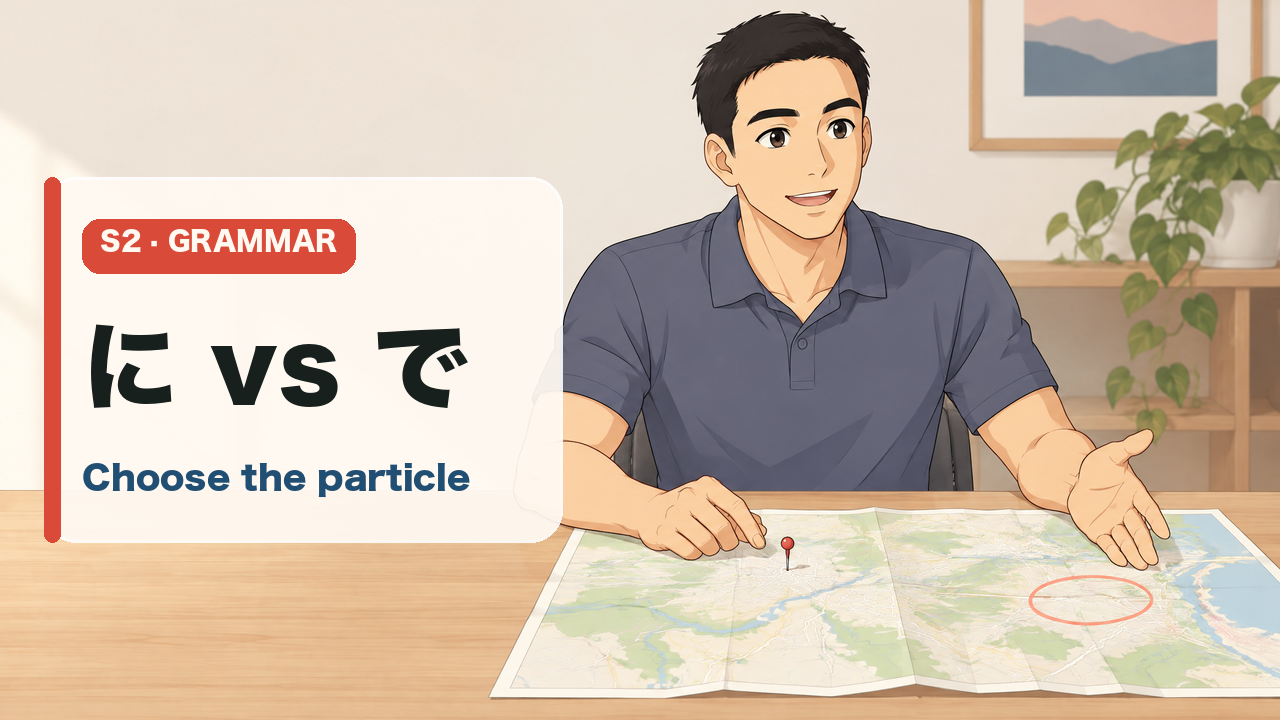
The difference between に(ni)and で(de)is one of the trickiest grammar points for Japanese learners. But here's the good news: you can understand it with one simple image—a map app on your phone.
In this guide, you'll learn how these two particles work like two different camera angles to show locations in Japanese. We'll break it down into 3 practical lessons.
Part 1: Basics — The Pin and the Action
Where you are, where you do it
5 secondsThe example sentences, recorded one by one.
Read the transcript
私は家にいます。
I'm at home.
家でごはんを食べます。
I eat at home.
Where people and things are
6 secondsThe example sentences, recorded one by one.
Read the transcript
猫は部屋にいます。
The cat is in the room.
机の上に本があります。
There's a book on the desk.
Listen to the pin and action rule
50 secondsA clip from a short YouTube video, explanation included.
Read the transcript
In English, we use “in” for many situations.
But in Japanese, translating “in” directly is a common trap.
Today, we fix it with one simple image: a map app.
Choose "ni" or "de".
"Tokyo ( ) imasu"
(EN) I’m in Tokyo.
"Tokyo ( ) tabemasu"
(EN) I eat in Tokyo.
First, the answers:
"Tokyo ni imasu"
(EN) I’m in Tokyo.
"Tokyo de tabemasu"
(EN) I eat in Tokyo.
Imagine a map on your phone.
1. "ni" = a pin 📍
Just a point: “here”.
No action.
に vs で: Two Different Camera Angles
Imagine a map app on your phone:
に = A pin 📍
- Just one point on the map
- "Here" as a location
- No action—it's still and quiet
で = Action 🖐️
- Something happens at that place
- You eat, buy, or speak
- There's movement and activity
Basic Examples
Example 1: Being at home
「家にいます。」 (I'm at home.)
- The verb「い」just means "to be"
- No action—only location
- It's a pin on the map
Example 2: Eating at home
「家で食べます。」 (I eat at home.)
- The verb「食べる」is an action
- You do that action at that place
- So we use「で」
The Most Common Mistake
If someone says:
「レストランに食べます。」(❌) (Sounds wrong)
Native speakers think: "Wait, what?"
Why? Because:
- に = Pin (location)
- 食べます = Action (to eat)
The pin and the action don't match.
Correct form:
「レストランで食べます。」(⭕️) (I eat at the restaurant.)
Note for advanced learners: 「レストランに食べに行きます」is correct. But「レストランに食べます」is not.
Quiz 1 ✏️ Practice 1
Think of your answer before opening the solution.
Fill in the blank with に or で:
- 「スーパー( )バナナを買います。」(At the supermarket, I buy bananas.)
- 「東京( )います。」(I'm in Tokyo.)
💡 Show Answer
- 「スーパーでバナナを買います。」(Buying is an action)
- 「東京にいます。」(Location)
Part 2: Intermediate — Verbs That Change Between に and で
Where you live and where you work
12 secondsThe example sentences, recorded one by one.
Read the transcript
どこに住んでいますか。
Where do you live?
東京に住んでいます。
I live in Tokyo.
どこで働いていますか。
Where do you work?
東京のホテルで働いています。
I work at a hotel in Tokyo.
Listen to how the verb changes the particle
54 secondsA clip from a short YouTube video, explanation included.
Read the transcript
This part confuses many learners.
Remember:
"ni" = pin 📍
"de" = action 🖐️
Now choose:
"Tokyo ( ) sunde imasu"
"Tokyo ( ) hataraite imasu"
Answer:
"Tokyo ni sunde imasu"
(EN) I live in Tokyo.
"Tokyo de hataraite imasu"
(EN) I work in Tokyo.
Living is your home base.
Like your address.
A fixed point on the map.
So "ni".
Working is action.
You do things there.
So "de".
Tricky one:
"Densha ( ) norimasu"
This is "ni".
"Densha ni norimasu"
(EN) I get on the train.
Before: Home (platform)
Review of Basics
- に = Pin 📍 (location)
- で = Action 🖐️ (activity)
Tricky Verbs: 「住む」and「働く」
Now let's tackle more complex verbs:
The verb 「住む」(to live)
「東京に住んでいます。」 (I live in Tokyo.)
Why に?
- 「住む」refers to where you live (your base)
- It's like your "home address"
- It's a fixed point on the map
- So we use に
The word「住所」(address) comes from this same verb. It shows that「住む」is about location.
The verb 「働く」(to work)
「東京で働いています。」 (I work in Tokyo.)
Why で?
- 「働く」is an action
- You do many things there
- There's activity and interaction
- So we use で
A Tricky One: 「乗る」(to get on)
「電車に乗ります。」 (I get on the train.)
Why に and not で?
- Now you're at: the platform (home)
- After you'll be at: inside the train
- The train is your destination
- So we use に
Important: 「電車で」means "by train as a means of transportation." Example: 「電車で学校に行きます」(I go to school by train.)
Quiz 2 ✏️ Practice 2
Think of your answer before opening the solution.
Fill in the blank with に or で:
「バス( )学校に行きます。」
(I go to school by bus.)
💡 Show Answer
「バス(で)学校に行きます。」
Why:「行く」is an action. You use the bus to go (action), so it's で.
Quiz 3 ✏️ Repetition Exercise
Say these sentences with me:
- 「東京に住んでいます。」
- 「東京で働いています。」
- 「電車に乗ります。」
- 「電車で学校に行きます。」
Key Point: The verb determines whether you use に or で. In Preply, I check your usage in real conversation.
Part 3: Conversation — Real-World Mistakes to Avoid
Where you buy things
5 secondsThe example sentences, recorded one by one.
Read the transcript
どこでパンを買いますか。
Where do you buy bread?
駅の店で買います。
I buy it at the shop in the station.
Listen to に and で in conversation
56 secondsA clip from a short YouTube video, explanation included.
Read the transcript
In real conversation, choosing "ni" or "de" matters.
If you choose wrong, it sounds strange.
1. “Where are you now?” = pin
"Doko ( ) imasu ka?"
"Doko ni imasu ka?"
(EN) Where are you now?
2. “Where shall we meet?” = action
"Doko ( ) aimasu ka?"
"Doko de aimasu ka?"
(EN) Where shall we meet?
This sounds strange:
"Ashita, doko ni tabemasu ka?" (❌)
(EN) (Sounds wrong) Where do you eat tomorrow?
Eating is action.
Correct:
"Ashita, doko de tabemasu ka?" (⭕️)
(EN) Where do we eat tomorrow?
Which restaurant are we eating at tomorrow?
Roleplay quiz:
Review: に = Pin 📍 / で = Action 🖐️
Real Conversation: 「どこに」vs「どこで」
When you invite a friend and use the wrong particle, it sounds off. But the rule is the same.
Case 1: Asking where someone is now
「どこにいますか?」 (Where are you now?)
Why に:
- You want to know their current location
- You're asking about a pin (their position)
- So に
Case 2: Asking where to meet
「どこで会いますか?」 (Where shall we meet?)
Why で:
- 「会う」(to meet) is an action between two people
- You're doing something together
- So で
The Classic Mistake
「明日、どこに食べますか?」(❌) (Where do you eat tomorrow? — Sounds wrong)
Why is it wrong?
- 「食べる」is an action
- Eating is an activity
- It should be で
Correct form:
「明日、どこで食べますか?」(⭕️) (Where do we eat tomorrow?)
Mini Dialogue
A: 「明日、どこで会いますか?」 (Where shall we meet tomorrow?)
B: 「駅で会いましょう。」 (Let's meet at the station.)
A: 「今、どこにいますか?」 (Where are you now?)
B: 「家にいます。」 (I'm at home.)
Roleplay Quiz
I say a sentence. You ask "where" using どこ:
I say:
「明日、パーティーをします。」 (I'll have a party tomorrow.)
You ask: (3 seconds)
Answer:
「どこでしますか?」 (Where will you have it?)
Why:「する」is an action. You're having a party, so it's で.
Summary: How to Use に vs で
| Usage | Pattern | Example |
| Show location | に(Pin) | 東京にいます (I'm in Tokyo) |
| Enter a place | に(Pin) | 電車に乗ります (I get on the train) |
| Live somewhere | に(Pin) | 東京に住んでいます (I live in Tokyo) |
| Do an action | で(Action) | 家で食べます (I eat at home) |
| Work somewhere | で(Action) | 東京で働いています (I work in Tokyo) |
| Use transportation | で(Action) | バスで学校に行きます (I go to school by bus) |
| Actions with others | で(Action) | 駅で会いましょう (Let's meet at the station) |
▶️ Videos for this article:
The Map App Theory of NI and DE explained in 3 videos. Watch them alongside the article:
- (1/3) The Map App Theory — Lesson 1: Pin (NI) and Action (DE)
- (2/3) The Train Trap — Lesson 2: The verb changes the particle
- (3/3) Real Conversation Skills — Lesson 3: Real conversation practice
🎓 Want to Learn More?
Would you like to practice with me on Preply?
On YouTube, I teach the rules. But on Preply, we practice conversation. I can check your に and で usage and help you speak natural Japanese.
See you soon! Chao chao!
And if you haven't already, hit that subscribe button! New lessons drop every week.