
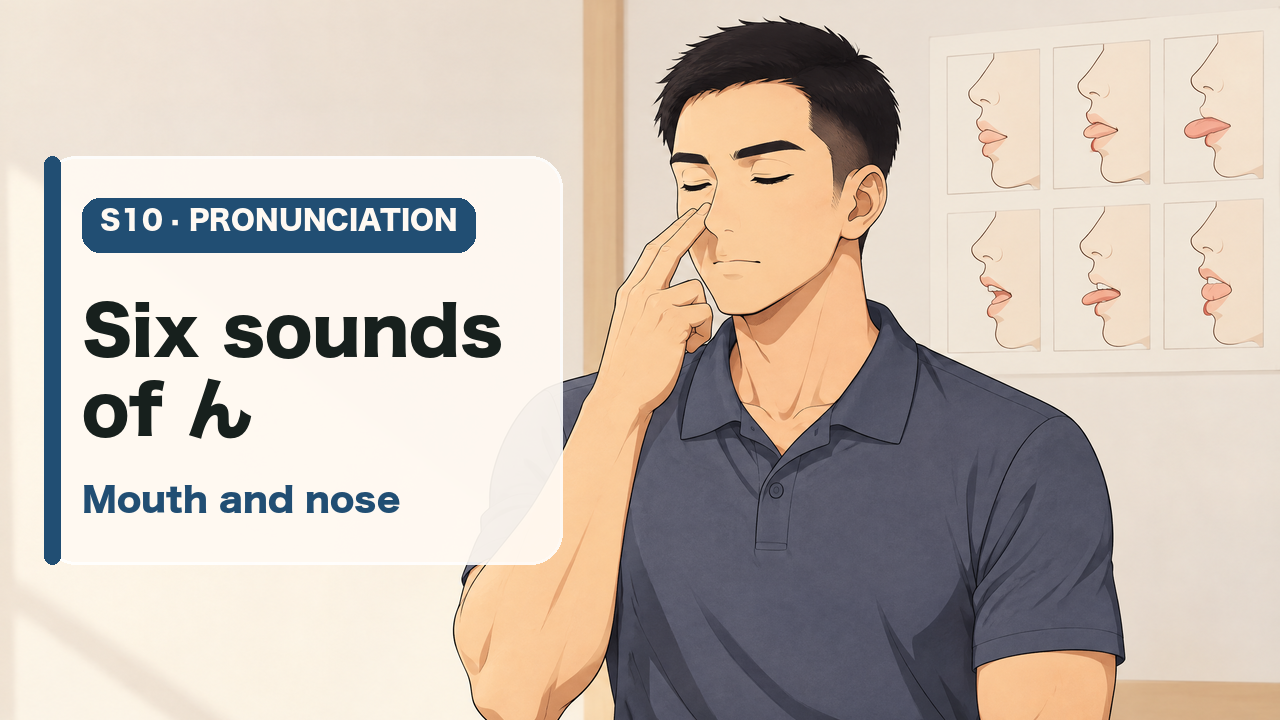
The Japanese kana ん does not always have exactly the same sound. It moves toward the place where the next sound is made. This article gives you a clear way to hear the difference.
1. Six changes to listen for
| Following sound | Mouth and nose feeling | Example |
| b, p, m | The lips prepare to close | しんぶん, newspaper |
| t, d, n, r | The tongue moves toward the area behind the teeth | あんぜん, safe |
| ch, j | The front of the tongue rises | はんにち, half a day |
| k, g | The back of the tongue rises | ぎんこう, bank |
| Vowels, y, w | The mouth stays more open and the sound remains nasal | れんあい, love |
| Word-final position | The sound ends through the nose without a strong tongue position | にほん, Japan |
These six labels are listening guides. Do not exaggerate them in conversation.
2. Feel the mouth and nose
Place a finger under your nose and say ん slowly. You may feel a small vibration. Now compare しんぶん, ぎんこう, and れんあい. Your lips or tongue prepare differently because of the sound that follows.
3. Keep the mora rhythm
Counting the beats
4 secondsThe example sentences, recorded one by one.
Read the transcript
ほ・ん。
book, in two beats
せ・ん・せ・い。
teacher, in four beats
At natural speed
5 secondsThe example sentences, recorded one by one.
Read the transcript
ほん。
book
せんせい。
teacher
かんたん。
easy
In Japanese rhythm, ん takes one mora. Do not delete it or squeeze it into the previous vowel. For example, ほん has two beats: ほ・ん. Practice せ・ん・せ・い and か・ん・た・ん with four steady beats.
4. Examples in sentences
Connecting ん to the next sound
9 secondsThe example sentences, recorded one by one.
Read the transcript
しんぶん。
newspaper
ぎんこう。
bank
新聞を読みます。
I read the newspaper.
銀行へ行きます。
I go to the bank.
- しんぶんを読みます。I read the newspaper.
- ぎんこうへ行きます。I go to the bank.
- にほんで勉強します。I study in Japan.
Keep the number of beats first. Then let ん connect naturally to the following sound.
5. Video and reference
YouTube video: the link will be added after the video is published. The video will compare lip movement, tongue movement, and nasal resonance.
For a technical table of Japanese places and manners of articulation, see the Japanese sound and IPA reference for teachers.
6. Two explanation levels
The Japanese N5 version uses simpler language. You can also read the [Japanese N5 version](/ja/n-secrets) to review mora rhythm. The N5 and N4 labels describe the readability of the explanation; they do not guarantee JLPT coverage.
If you want personal feedback on your pronunciation, you can book a Japanese trial lesson.